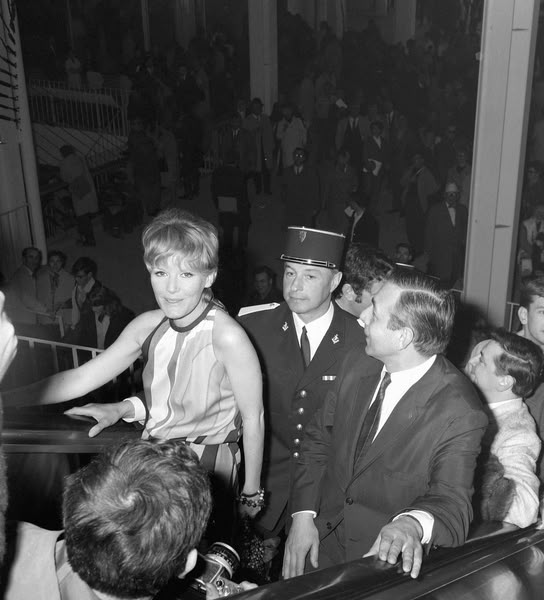
Petula Clark has often spoken about her concerts at Place des Arts in Montreal in 1969, a time when Quebec’s separatist politics was very much alive. Petula encountered the political tension during her performances and it ultimately led to her unexpected participation in John Lennon and Yoko Ono’s famous bed-in recording of “Give Peace a Chance.”
In a 2017 interview with the Montreal Gazette, Petula recalled what happened:
“When Clark sang in French, the anglophone half of the audience would break out in catcalls; when she sang in English, the francophone half would do the same. “It was like open war,” recalled Clark, still sounding a little bewildered by it all. “I couldn’t win. I was really heartbroken. I needed someone to talk to. I had never met John (Lennon), but I knew he was in town. I remember it was pouring with rain, and I walked over to the (Queen Elizabeth) hotel, a far enough walk to get drenched. I went up, no security whatsoever. The door was open and there John and Yoko were, sitting on the bed. I walked in looking like a drowned rat, crying.“
Petula was consoled by Lennon who invited her to join a group who had gathered in the hotel suite where the famous recording took place.
But Petula had actually been a star in Quebec before she became widely known in the rest of North America. Her success in France and her popularity there had spilled over into Francophone Canada where she had performed in French and where she had recorded a television show sponsored by General Motors, which aired on French-language private stations. In fact, in January 1965, Petula had a week-long engagement at the Comédie Canadienne (now Théâtre du Nouveau Monde) in Montreal, just as “Downtown” was rising on the North American music charts. When pleas from Ed Sullivan for Petula to come to New York to perform “Downtown” on his show came pouring in, her commitments in Quebec prevented her from rushing immediately to New York. So, understandably in the 2017 Gazette Interview Petula proclaimed, “Quebec has been a very special place for me”.
Another indication of that importance occurred in 2000 when Petula began what she dubbed her “One Woman Show “in Montreal. The Globe and Mail reporter Martin Siberok reported on it :
“Every once in a while a performer comes along who doesn’t get the credit she deserves until you see her live. For me, that performer is Petula Clark. The full house that was on hand at the St.Denis Theatre on Saturday night was taken on a journey through the life and career of the British superstar — a career that has lasted more than 50 years …While I went to the concert knowing how much I loved {her}hits, I came away with a vastly increased respect for Petula’s talent as a singer. Her performances of songs from her Broadway career like Sunset Boulevard, Blood Brothers, and from her films Finian’s Rainbow and Goodbye Mr. Chips really showed her considerable abilities as a vocalist.”
That review echoed the sentiments that had motivated my husband and me to seek out Petula’s performances near and far over so many, many years.
But our first experience of a Petula bilingual performance did not occur until November 2010, in Montreal at a concert at Théâtre St-Denis. It was wonderful for us to hear Petula sing live for the first time some of her French hits such as “Chariot,” “La Gadoue,” “Un Enfant,” “La Nuit N’en Finit Plus,” and “Que Fais-tu Là?”. “Chariot” remains my personal favorite, but her encore performance of “Tout Le Monde” was a rousing crowd-pleaser.
One especially memorable moment in that concert occurred when someone in the audience shouted out a birthday wish—Petula’s birthday was a few days away. Though Petula had long been known for shunning birthday celebrations, the spark was lit, and the audience spontaneously broke into the “Happy Birthday” song. We had actually seen Petula perform in a completely English show a few days earlier at Northern Quest Resort near Spokane, Washington, in the US and it too had been a wonderful concert. I remember thinking that the French audience were more lively and effusive in their response–their appreciation was really palpable. Maybe it was just the birthday song !
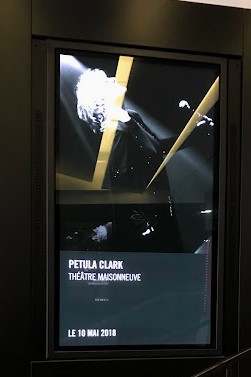
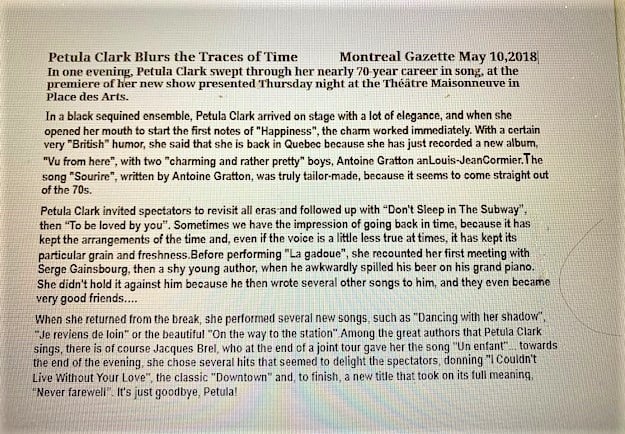
Petula’s most recent forays into French Canada and Montreal surrounded her recording of a series of songs all composed by French Canadians and featured in her “Vu D’Ici album. Phillipe Rezzonico in Rue Rezzonico.com described her May 10, 2018 performance at Place des Artes:
…She may be a certain age, but it’s still fascinating how much Petula Clark has retained a vitality… Mischievous, like a little girl, when she waves by grabbing the corners of her dress, she performs Sourire (Antoine Gratton) as if it were a 1960s hit, as well as La gadoue and Tout le monde veut aller au ciel with exuberance.
On the other hand, she knows how to be touching for Cœur blessé , overwhelming for Un Enfant (written for her by Brel), intense and dramatic for La nuit d’en finit plus ( Needles and Pins , by the Searchers) and downright gigantic for La chanson d’Evita ( Don’t Cry For Me Argentina ). If she displays less vocal power than in 2010, she still has plenty to conclude Chariot and I Couldn’t Live Without Your Love in the heights. Frankly, had it not been for the fact that the stand of her microphone frequently served as a reference point, we would have thought we were in a previous decade as the lady’s timbre is still on point.
My husband and I were there for the May 10 concert which Rezzonico so aptly describes. We were enthralled by the new songs and even though Canadian, we are not bilingual but Petula’s ability to translate meaning and emotion compensated for what we missed in the lyric . We left the theatre having “experienced” something wonderful .
Montreal is a wonderful city. Its bilingual charm and European ambiance make it a truly special place. We visited many times in the late ’90s while our daughter was attending university there, and we welcomed the opportunity to return during Petula’s concerts.
The cobblestone streets of Old Montreal and the Old Port, Notre Dame Basilica, the breathtaking views from Mount Royal, Place des Arts, the McGill campus, and the shops along Sainte-Catherine Street are all places to visit again and again.
You can also still explore the original site of Canada’s 1967 World’s Fair, Expo ’67, on Île Sainte-Hélène and Île Notre-Dame, now known as Parc Jean-Drapeau. Remnants of Expo 67 remain, including the Biosphère and the Casino de Montréal. Petula has an important connection to Expo 67: she appeared in a special episode of The Ed Sullivan Show broadcast from the fairgrounds in May 1967. My husband and I made the trek to the fair later that summer, though we sadly missed Petula’s performance.
Our last visit to Montreal was in June 2019 to attend what turned out to be Petula Clark’s second-to-last full concert to date. The performance took place at the beautiful Théâtre Maisonneuve in Place des Arts, as part of the Francos de Montréal festival. It had been a year since Petula released her French-Canadian album Vu d’ici, and the setlist closely mirrored the one from her tour the previous year.
Two songs really stood out for me. The first was her opening song after intermission—“Sauve-moi.” I had never heard Petula sing the song live before, and oh my, her delivery was nothing short of spectacular. The second highlight came when she sang a French rendition of Anthony Lloyd Webber’s Don’t Cry for Me Argentina. The audience responded with a standing ovation, and seemingly non- ending applause. I thought I had long passed the point of being astonished by Petula, but that performance defied all expectations. It was truly an unforgettable night!
Merci, Petula and Montreal for the wonderful memories.


 Petula Travellers
Leave a comment